CIP and Sanitation Notes for Rice Sweetener Plants
In a rice sweetener plant, sanitation is not only a food safety requirement. It is a production stability issue.
Residual starch, protein, fine rice solids, syrup film, and mineral scale can quietly change how a line behaves. A liquefaction vessel may heat unevenly. A filter may blind faster than expected. A saccharification tank may show inconsistent conversion from one batch to the next. Finished syrup may move differently through pipes, heat exchangers, and evaporators.
For plant teams working with Komeva as an enzyme supplier for rice syrup production, clean process surfaces help protect the value of the enzyme program: predictable viscosity reduction, stable hydrolysis, consistent filtration, and repeatable syrup quality.
This note is written for production, QA, sanitation, and maintenance teams looking at CIP performance through a plant-floor lens.
Why CIP matters more in rice syrup lines
Rice-based sweetener production has several sanitation challenges that are easy to underestimate.
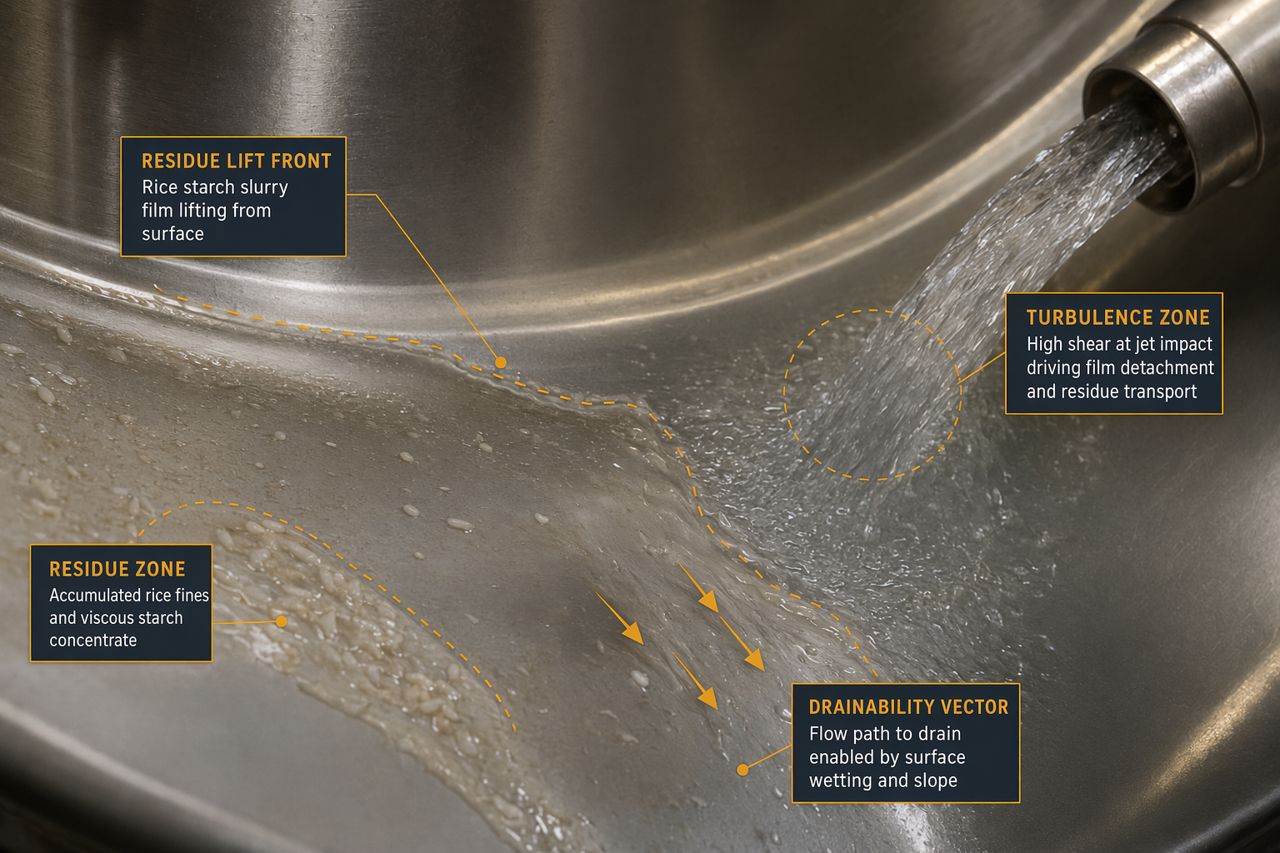
Rice starch slurries can form adhesive residues when heated. Partially converted starch can leave viscous films in dead legs, transfer lines, and tank surfaces. Protein and fiber fines can lodge in elbows, screens, and filter housings. Syrup concentration steps add sticky high-solids deposits that are harder to remove after cooling.
When these residues remain in the system, they can affect:
- Slurry heat transfer and temperature uniformity
- Enzyme contact with starch substrate
- Viscosity drop during liquefaction
- Filter cycle length and differential pressure behavior
- Color control and off-note risk
- Microbial control between production windows
- Batch-to-batch conversion consistency
- Unplanned downtime for manual cleaning
A good CIP program does not just make equipment look clean. It helps the process run the same way tomorrow as it did today.
Start with the soil profile, not the chemical drum
Effective sanitation begins by identifying what is actually on the equipment.
In rice sweetener plants, common soil types include gelatinized starch, dextrinized starch residues, rice proteins, insoluble fines, syrup films, mineral deposits, and heat-baked layers near exchangers or evaporators.
Each soil behaves differently. A sticky syrup film may need strong flow and temperature. A mineral deposit may need an acid step. A starch film trapped in a low-flow area may need mechanical correction before chemistry can solve the issue.
Before changing a CIP recipe, review:
- Where the residue appears
- Whether it is starch-like, protein-like, mineral-like, or syrup-like
- Whether it occurs after a specific product grade or operating condition
- Whether the problem is chemistry, temperature, flow, drainage, or equipment geometry
- Whether the issue repeats by vessel, line, valve cluster, or shift
This keeps sanitation troubleshooting practical and avoids overcorrecting with stronger chemicals when the real issue is flow coverage or hold-up.
CIP design points that affect enzyme-supported production
1. Pre-rinse quality
A strong pre-rinse removes bulk soil before chemical cleaning begins. In rice syrup lines, this step matters because heavy starch and syrup residues can consume cleaning chemistry quickly.
Watch for cloudy discharge that stays cloudy too long, visible grain fines, slow-draining sections, or syrup strings during the initial rinse. These are signs that residues are not being displaced efficiently.
2. Flow velocity and turbulence
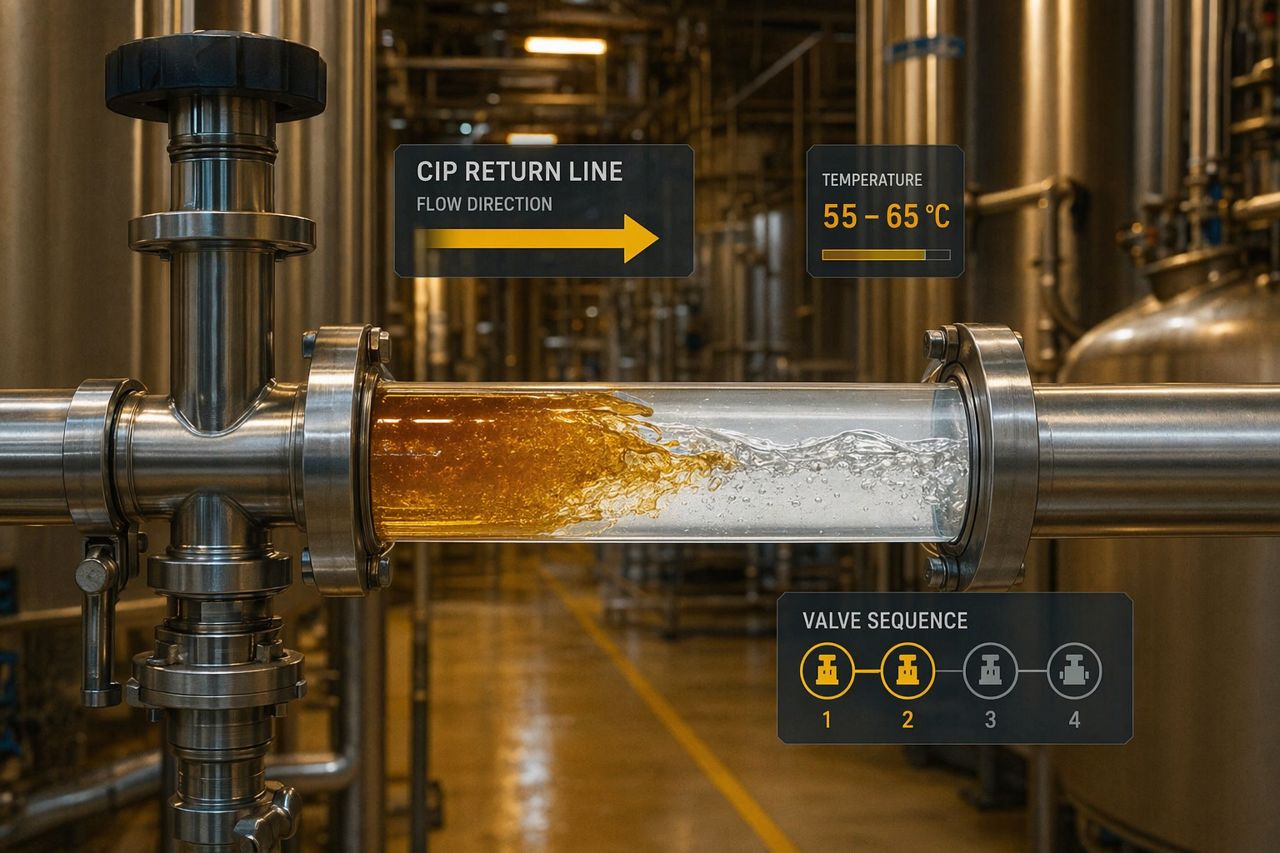
Chemical strength cannot compensate for poor contact. Long transfer lines, complex valve manifolds, dead legs, undersized returns, and low-flow branches can leave deposits behind.
If the same location repeatedly causes microbial counts, odor, filter instability, or startup viscosity issues, confirm whether the CIP circuit is delivering enough turbulence to that area.
3. Temperature consistency
Temperature swings can change cleaning performance. Too cool, and viscous soils may remain attached. Too hot in the wrong step, and some residues may become more stubborn.
Stable temperature control is especially important after liquefaction, saccharification, evaporation, and holding steps where starch and syrup residues can become more adhesive.
4. Drainability
Standing water, diluted chemicals, and syrup pockets increase sanitation risk. They can also create inconsistent startup conditions when the next batch begins.
Check low points, valve bodies, pump casings, sample points, instrument ports, flexible connections, and filter housings. A line that cleans well but drains poorly is still a risk.
5. Verification beyond appearance
Visual inspection is useful, but not enough. Rice syrup residues can be thin, transparent, and difficult to see on stainless steel.
Plant teams should use appropriate internal verification tools and trend the results by circuit. The goal is not only pass/fail documentation. The goal is learning which parts of the process are drifting before they create downtime.
Sanitation links to viscosity and filtration
CIP performance and process performance are connected.
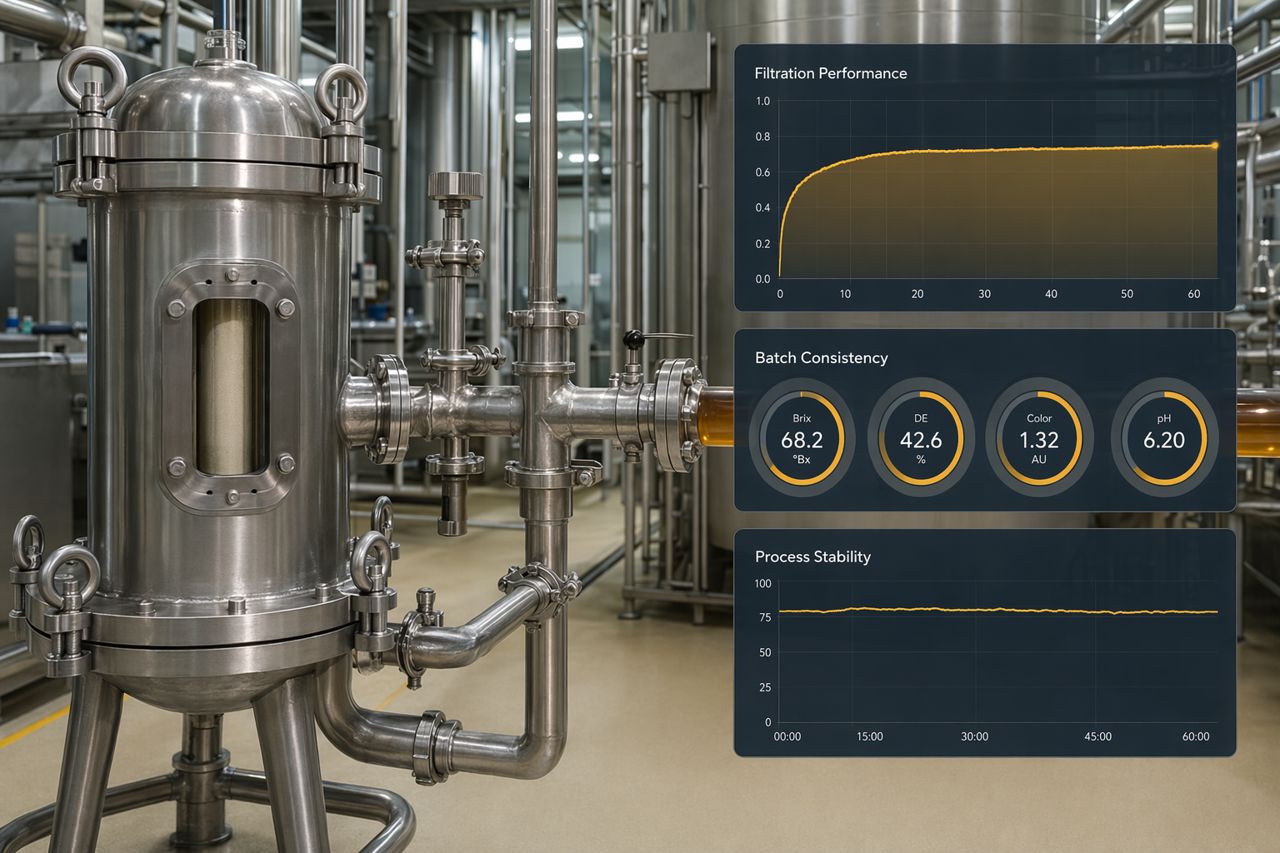
If residual starch remains in a slurry line or liquefaction vessel, the next batch can begin with uneven solids distribution or unexpected viscosity behavior. If old syrup film remains in a transfer line, it can alter color, flavor, or microbial risk. If filter housings are not fully cleaned, the next run may experience faster blinding even when upstream conversion appears normal.
In enzyme-supported rice syrup production, sanitation helps protect:
- Consistent liquefaction startup
- More predictable viscosity reduction
- Stable saccharification conditions
- Cleaner filtration curves
- Fewer mid-run pressure surprises
- Better evaporator and finishing performance
- More reliable finished syrup specifications
Komeva technical discussions often include both enzyme selection and operating discipline because the two are connected in real production. A well-matched enzyme program works best when the line is clean, drained, and ready for repeatable contact between substrate and enzyme.
Common CIP trouble signals in rice sweetener plants
Production teams should investigate sanitation when they see recurring patterns such as:
- Viscosity reduction takes longer than usual at startup
- Filter pressure rises earlier in the cycle
- Fine haze or insoluble carryover increases
- Finished syrup color drifts without a clear raw material change
- Evaporator fouling becomes more frequent
- Holding tanks show inconsistent odor or microbial trends
- Operators need extra manual rinsing between runs
- The first batch after shutdown behaves differently from later batches
These symptoms can have multiple causes. Raw material variation, enzyme dosing strategy, pH control, temperature control, and residence time all matter. But CIP should be part of the investigation, not an afterthought.
Practical sanitation review checklist
Use this checklist during a plant review or troubleshooting walkdown.
Equipment and circuit review
- Are all product-contact surfaces included in a validated CIP circuit?
- Are there dead legs, unused ports, bypasses, or manual hoses that retain syrup or slurry?
- Do valve clusters open and sequence correctly during cleaning?
- Are tanks, transfer lines, filters, and heat exchangers cleaned as complete circuits or partial loops?
- Are high-solids syrup lines treated differently from low-solids slurry lines?
Process residue review
- Where is starch film most likely to form?
- Where do rice fines accumulate?
- Where does syrup cool and become more viscous?
- Which equipment sees the longest hold times?
- Which surfaces are exposed to repeated heating?
Operating discipline review
- Are rinse times long enough to remove bulk soil before chemicals are introduced?
- Are temperatures, concentrations, flow rates, and return conditions recorded consistently?
- Are operators seeing foam, slow returns, blocked spray devices, or erratic conductivity trends?
- Are circuits inspected after maintenance or valve replacement?
- Are deviations linked back to product quality and downtime records?
Working with Komeva on process consistency
Komeva supplies enzyme solutions for rice syrup production with a focus on plant-level outcomes: stable yield, controlled viscosity, smoother filtration, repeatable conversion, and dependable technical support.
When a rice syrup factory evaluates enzyme performance, Komeva looks beyond the enzyme drum. We discuss raw rice quality, slurry preparation, liquefaction conditions, saccharification targets, filtration behavior, evaporation impact, sanitation discipline, and practical production constraints.
That broader view helps plants separate enzyme-fit questions from operating-condition questions. It also helps identify where small process corrections can reduce downtime and improve batch consistency.
When to request technical input
Consider contacting Komeva if your plant is dealing with:
- Unstable viscosity after liquefaction
- Short filter cycles or unpredictable filtration pressure
- Inconsistent conversion between batches
- Repeated fouling after cleaning
- Product grade changes that require enzyme adjustment
- New rice raw material sources
- Capacity increases that stress existing equipment
- A planned review of enzyme cost-in-use and syrup yield
The right enzyme recommendation depends on the actual process. Komeva can help review your operating targets and propose a practical supply and support plan for rice syrup production.
Request a quote
If you are reviewing enzyme supply for a rice syrup factory, send Komeva your production goals, raw material profile, and current process challenges through the on-site request a quote form.
Request a quote from Komeva to discuss enzyme options for stable viscosity control, filtration behavior, and consistent rice syrup output.